The Cardio Debt Fallacy
"I've eaten like a pig. I should burn it all out by doing extra cardio tomorrow." We've all heard it at a party. Maybe said it ourselves. It sounds responsible — you overdid it, so you'll balance the books on the treadmill. Except the math doesn't work the way you'd hope.
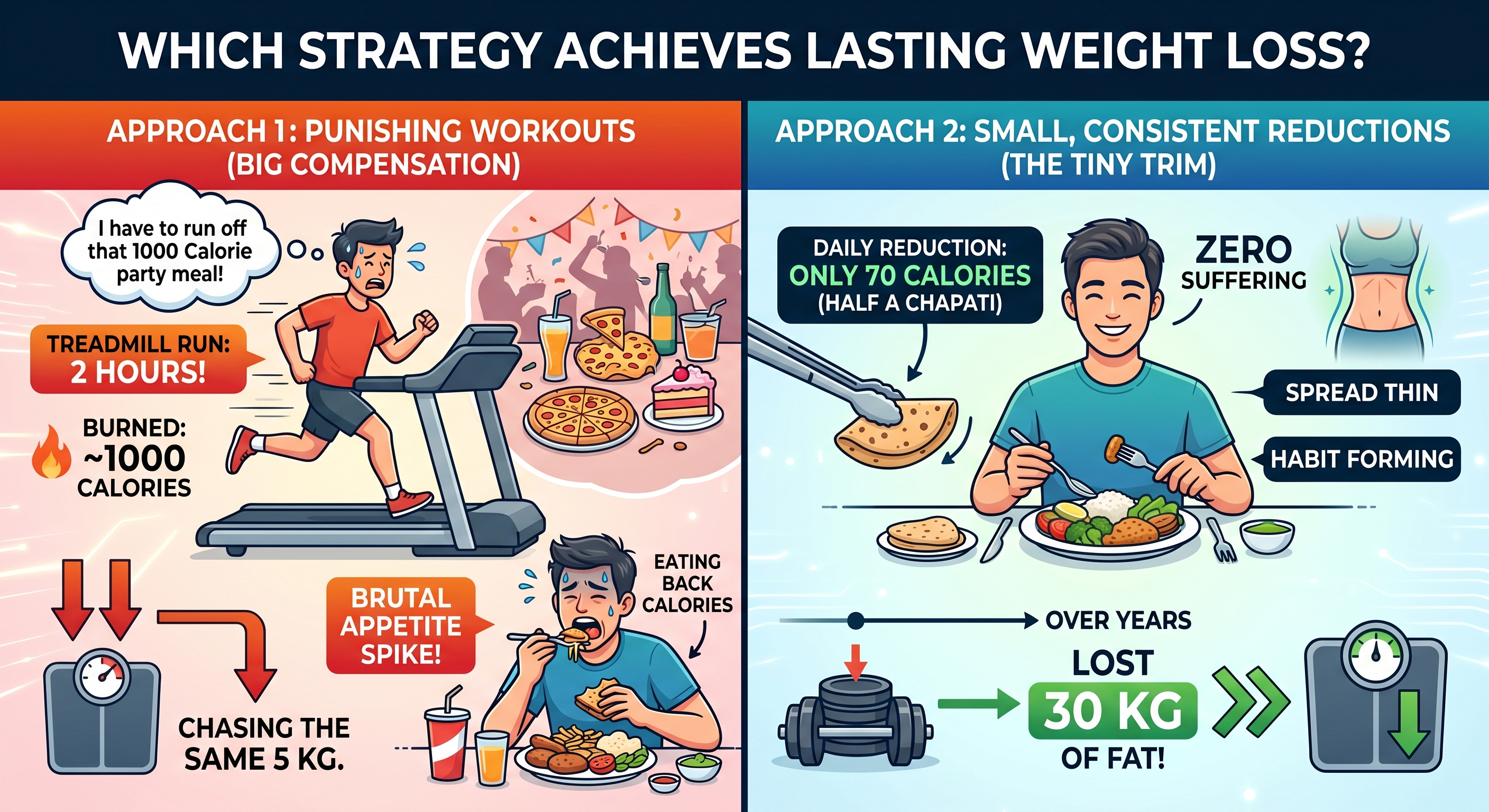
That big night out? Let's say it was a 1000 Calorie surplus. Burning 1000 Cal on a treadmill takes roughly two hours of running. Two hours. Most people can't sustain that, and the ones who can will be so hungry afterward that they eat most of it back anyway.
Here's the alternative: eat 70 Cal less than your usual plan for 15 days. That's removing half a chapati. 70 × 15 = 1050 Cal — same deficit, zero suffering, spread thin enough that you won't even notice. The party never happened.
And here's what most people miss — you don't need to know your real maintenance number to make this work. Nobody knows this, not precisely. What matters is building a tracking habit. Once you've tracked consistently for a few weeks, you develop a personal reference — a baseline. Maybe your tracker reads 2200 Cal when your actual maintenance is closer to 2400 Cal. Doesn't matter. Because subtracting from your reference guarantees a real deficit regardless — because you have established that you neither gain nor lose weight (measured as weekly averages) when your tracker says you've 2200 Cal on an average.
Separately, your tracking accuracy sharpens over time — one app says a serving of butter chicken is 350 Cal, another says 475. You learn which sources to trust, how much to punch in. But to start with, the habit itself does most of the heavy lifting long before your numbers get precise.
Running 5km burns about 300 Calories. That's one samosa. The samosa took 30 seconds. The run takes 30 minutes. It's simply easier to not eat the samosa. This isn't anti-cardio — running, swimming, cycling are phenomenal for your heart, your lungs, your mood. But as a tool for creating a caloric deficit, cardio is wildly inefficient compared to just eating a little less.
Marathon runners are a living example. They burn thousands of Calories in a single session — and many of them eat back everything and more. The appetite spike after sustained cardio is real, and it's brutal.
Your average intake over years is what determines your body composition. Not single meals. Not single workouts. The guy who ate 70 Cal less every day created enough of a deficit to lose over 30 kg of fat over the years. The guy who ran punishing treadmill sessions after every party is still chasing the same 5 kg. Stop thinking in same-day debt payoffs. Think in weekly averages. Think in trends.
This topic is covered in depth in Practical Application of the Calorie Model.